Things to think about in transitioning from a private practice to hospital-owned practice – productivity, pay, and metrics

Browsing the other day I came across a question asking about salary metrics.  A multi-specialty group (MSG) was looking at a sale to a hospital.  All providers were on flat salary.  (uh oh)   
Paying everyone a flat salary in a single specialty group (SSG) communicates that you are being paid for your time, not necessarily productivity.  This may work in some models (dept. of health clinics, clinics targeting the underserved, etc…) but in a SSG with multiple physicians, it will eventually cause problems as 1) different physicians have different productivity naturally and 2) paying a flat salary regardless of income is fiscally dangerous – you can’t spend more than you earn.   This approach may flatten productivity in a ‘lowest common denominator effect’.  

At the other extreme, is ‘eat what you kill’.  This creates a vicious practice environment where partners fight over high RVU & highly paid work, and ‘dump’ the unpaid or poorly paid work on each other, other clinicians, anyone they can!  Younger, less connected members of the group are taken advantage of by older, savvier partners.  This kind of practice (and they do exist!) is where medicine gets its reputation of “eating its young.”  It is an anti-collegial system, and results in high turnover, a lower level of overall care, possible legal risk, and ultimately a lawsuit when the providers split up.

So, how to resolve this problem?

1.  Its important that you KNOW your provider’s productivity.  How many RVU’s?  How many patients seen?  How many procedures?  What are their charges?  What are their receivables? You need to measure these items.  Billing records may give a reasonable approximation.  Consider basing productivity on charges, not revenue, as different payor mixes may have different reimbursement, and swapping a provider to another site/shift might account for differences in recovered revenue.  Also see discussion below in #3 for philosophy.

2.   Once you know the average productivity of the providers, then you can establish the level of salary from MGMA for a group of that % of productivity.  Consider establishing the base salary at a slightly lower level (i.e. if average group productivity is 65%tile – 85%tile, set your base salary at the 65th%tile not the 75th%tile mean) so that less productive members of the group are not dismissed at the first opportunity if they are not meeting productivity measures.  In a MSG setting, it might be better to treat it as a bunch of single specialty group contracts negotiated under a master agreement.

3.   Establish a bonus based upon excess RVU’s to encourage productivity.  Be careful here, as solely basing the bonus on RVU’s can cause the group to lose cohesiveness and collegiality.  Even better, if you can model it correctly, use a hybrid model of RVU’s, # of patients seen, total $ amount of charges.   This last part is important, as one of the big advantages of being a hospital-owned group is the ability to be separated (in theory) from accounts receivable.  Bottom line – providers are doing the work, and the hospital is doing the collection.  You (the providers) need to be paid for your work & the hospital needs to collect.  If the hospital is not able to collect, that is beyond your ability to control in a hospital-owned practice, and ultimately not your responsibility (although you must do everything in your power to help them collect by coding properly & compliantly).  It is a shift in thinking from shareholder to employee.  One neat thing that you can do here as a MSG is set a ‘group bonus’ tied to the overall productivity of EVERYONE now in the MSG swept into the hospital group and a separate ‘individual bonus’.  That might go a long way to maintain the culture which existed in the MSG and keep the providers happier. 

4.  Nobody likes to do work that they are not paid for.  So for administrative duties (chairmanships, committees, etc…) negotiate a small(er) bonus for that specific work.

5.  There are quality measures that need to be met under meaningful use criteria, and the hospital leadership may have set their own performance measures.  There should be a small bonus for meeting these measures as well as a small demerit for not meeting them. (+/- 0-2%?)  This should modify the overall group and individual productivity bonus to discourage folks from boosting RVU’s at the expense of quality measures.

6.  For call, you might be wise to negotiate a flat rate per call with the hospital (specialty-specific).  That way, those who hate call can ‘sell’ their call to those who like to take call or who are hungrier for earnings.  If you do so, you MAY need to hold the call earnings out of the RVU pool as otherwise those who take more call will have more RVU’s and skew the bonus pool.  However, the calculation may be difficult to do.  

7.  Finally, once you go through this process you can standardize a day’s pay, and those who want to work less can buy vacation days from those who want to work more.  This is a nice option if available.

8.   Be really clear about the metrics established for performance evaluation, promotion, and bonuses.  Try to make it fair but don’t provide incentives for uncollegial behavior, substandard care, etc…  It will save money and heartache later.  See previous post on “The measure is the metric.”  Solely basing employment on RVU targets is risky.

Z.B.  While I think its fine to ask on the net about options, there is no substitute for specific, expert advice from someone who has gone through this process before – preferably multiple times!  Being that a MSG has the income of multiple physicians, I think that it would be wise for them to hire a consultant who has guided groups through this kind of transition and can evaluate the practice intimately under a NDA and provide specific recommendations (which this post is emphatically NOT).  Perhaps the questions and comments above may serve as a very rough beginning of a process which will lead to a successful cash-out and transition from private practice to hospital-owned practice. 
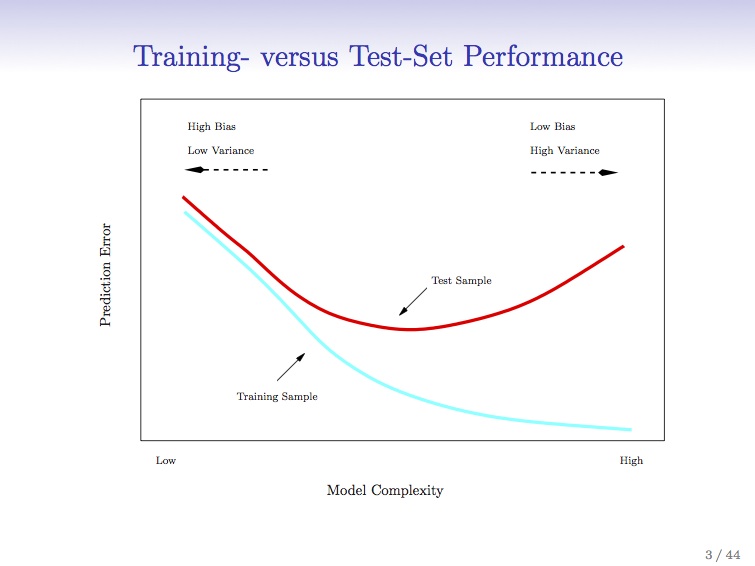
The trap of overfitting data – future directions in the blog (2014)

Quick thought for this Monday morning….

Overfitting

I’m taking Trevor Hastie’s and Robert Tibshirani’s fantastic Statistical Learning course online through Stanford.
The slide here is great – and shows the danger of complex models and overfitting.   For the data scientists – cross validation.  If any system traders or finance people are reading, think walk-forward analysis.  

Basically, what the graph says is that when you apply a better and better model with higher levels of refinement to your system, you ‘fit’ your established data more accurately.  However, because the system is more complex, it is more rigid and less flexible (degrees of freedom, anyone?) and less resilient.  Tracks the data better, but works less well in practice.  That’s why the red line starts going up again as the scale of complexity goes from low to high.  Does this resonate with any of the process improvement (PI) people who are six-sigma trained?  Once you scoop up the low-hanging fruit and pass that first or second sigma in iteration, things get tougher.  A lot tougher.  

This is the trap of curve-fitting (also known as overfitting).  More in this case is less, as the model fails to be predictive.  

Where I’m going in this blog is to integrate some of these concepts with resource allocation problems in healthcare; and their resulting effect on patient care.   I’m particularly interested in applying these techniques to predictive analytics in healthcare.  I think we can learn a great deal from the practical applications of these computational statistic tools which have been successfully applied (I know because I started my career doing it) to the markets on Wall St.   What medicine can learn from Wall St. is a topic I intend to cover  in a series of posts. But healthcare is not the markets, and can’t be approached entirely similarly.   The costs of error are catastrophic in terms of lives – it’s not just about money.  

I hope you stay with me as I develop this theme. 

Image from :https://class.stanford.edu/courses/HumanitiesScience/StatLearning/Winter2014/about

mHealth – what is the path forward?

I’m only getting started in learning about the mHealth community and applications.  But from the (limited) amount I can gather about this somewhat distributed ecosystem, it seems to be this:

1.  Lots of mHealth Apps out there.  
2.  Many designed without serious clinical input (i.e. mediocre or wrong information)
3.  Many designed without attention to UI (user interface) or UX (user eXperience).
4.  No connectivity to patient records = a failure of design.
5.  Few real users.

That’s why we’re not seeing a ton of mHealth apps exploding on the marketplace and multiple IPO’s.  Perhaps I’m being a bit harsh here, as we just might be early to the game.  But  the end result?

Problems:
1.  No one wants to PAY for wellness.  And more concerningly, there is no evidence that wellness works (1)
2.  Poor UI/UX, as described above.  
3.  No integration into patient portals or hospital EHR’s for the majority of users.  
4.  Data from apps not readily available to providers.
5.  No data from application to show that it is useful to clinicians.

Specifically targeting point #1 – aside from the motivated quantified health folks, how do we get the right app into the hands of the right people?  From my point of view, a progressive vertically integrated system – insurer – hospital – provider all rolled up into one – could target (hotspot) an area of cost excess or refractoriness in meeting ratios or a MU requirement.  Then, BUY the app & developers.  INTEGRATE it into the systems EMR in a way that the providers feel is useful and that should give a triple aim result.  Then DISTRIBUTE it to your hotspot in such a way that group members are motivated to use it & TRACK the results.  Win-win for everyone.

At  HIMSS 2014, the bulk of the discussion of mHealth was on mobile data management to meet HIPAA compliance.  Sensible, but suggests that the critical mass for actual clinical applications is not there, despite recent FDA liberation of rules for health apps.  

Source: Reuters, RAND corp.

(1)http://www.dol.gov/ebsa/pdf/workplacewellnessstudyfinal.pdf

The Quadruple Aim

I’ve heard a lot about the Triple Aim lately – the goal of:
Improving patient experience through both quality and satisfaction.
Improving population health (care)
Reducing the per capita cost of healthcare

Well, I think we should be thinking more inclusively, and for that I propose the Quadruple Aim:
Better Patient Satisfaction
Better Patient Outcomes
Better Provider Satisfaction
Reduced Cost

The difference is in structuring meeting the Triple Aim to include Provider Satisfaction. 

It is beyond the scope of this discussion, but the chatter from physicians is more negative than usual.  Granted, a lot of physicians are ‘glass half-empty’ types, but even so, the pervasive uncertainty about the future of their careers is widespread and palpable.  A number of articles about physician ‘burnout’ have been hitting the rounds lately, even from venerable sources like the New York Times. (1)  How does a profession that prides itself on hard work and a single-minded devotion to their patients go from discussion of exciting new medical cures to 50% burnout rates, even starting in medical school?  I find that difficult to understand – on a personal level, I couldn’t wait to get to work when I was in medical school on the wards – it was just so exciting and interesting!  So how did we get from there to this?

Perhaps mandating the triple aim without including physician well-being (provider satisfaction) has something to do with it?

1.http://well.blogs.nytimes.com/2012/08/23/the-widespread-problem-of-doctor-burnout/

The Physician & the Administrator – Rule Sets in Healthcare

I came across the idea of rule sets while reading Tom Barnett’s excellent The Pentagon’s New Map.(1)  Tom is a military strategist who was influential in the 1990’s-2000’s when the collapse of the Soviet Union left the US as the sole hegemonic power (this was before the 2008 Western financial crisis and China’s ascendancy).  I had the pleasure of corresponding with Tom on a few of his ideas which at the time seemed quite radical, but bore out to be accurate.  I’m not going to comment on his military and geopolitical views, as I’m only an armchair foreign analyst.  


Tom promotes the idea of “Rule Sets” – the combined written and unwritten rules that exist in a society or culture.  Entities that have similar rule sets interact and cooperate more effectively, and entities that have very different rule sets have difficulty synergizing well.  Ergo, western cultures (US & European) interface quite well as we have a shared belief system – representative democracy, protection of private property, freedom of religion, rule of law, etc…   However, cultures such as American and Azerbaijan may not interface easily as paternalism, tribal and familial patterns of voting and class, arranged marriages clash between the two cultures (apologies to any Azeris who feel I am unfairly singling them out for the purposes of example).


In healthcare today, we have different rule sets belonging to the various stakeholders involved in healthcare delivery.  The differences between these rule sets create friction in interaction, even when one group asserts dominance over the other.


The physician’s rule set is first and foremost governed by the Hippocratic “primum no nocere” (first do no harm) dictum.  As a result, most physicians are risk-averse, patient-centric, and conscientiously compliance focused, also stemming in part from a fear of malpractice and payment compliance problems.  They are also cognizant of the “captain of the ship” doctrine as it has applied to them (z.b. this may be changing in practice if not as quickly in case law) and are therefore independent and opinionated, not concerned about consensus-building as their decisions tend to be of the “buck stops here” variety.  Consumed by the frequent changes in the medical literature that make up the basis of their practice, they tend to be resistant to other forms of change.  Success is typically measured internally by the satisfaction derived from good patient outcomes, a patient at a time.


The administrator’s rule set is more nuanced with greater attention to soft skills, team and consensus building, and an avoidance of unnecessary risk.  Slow, iterative refinements punctuated by less frequent sweeping change either in response to market conditions or strategic initiatives are the rule.   For all but the highest level administrators, shared decision making is the rule, requiring buy-in from different organizational levels.  Institutional knowledge and know-how are as important as efficient execution and interpersonal skills.  Productivity enhancement is a sure key to success and greater roles in the organization.  Mid-level managers tend to be more narrowly focused, myopically on their own area of supervision and control, while higher level executives are responsible for institutional stewardship.  Success is usually measurable by numbers, either in a P&L basis, volume, time, or outcomes measures.  Responsible for many lives, the administrator focuses on population health measures.  


So, if physician’s rule sets and administrator’s rule sets are so different, how then are we to expect the two to collaborate successfully?


Perhaps a new rule set will need to be developed with commonalities both physicians and administrators?  


They already have one huge thing in common – the patient.


(1) Thomas P.M. Barnett (April 22, 2004). The Pentagon’s New Map. Putnam Publishing Group. ISBN 0-399-15175-3