The Measure is the Metric

There is a maxim in management circles to use data-rich methods of management.  Peter Drucker is reputed to have said, “What gets measured gets managed.” Clearly better than managing by the hem of one’s skirt (or seat of one’s pants), data-driven management allows for assessment of measured items.
It is interesting to consider the perturbations of this statement:
-if it can be measured, it can be managed (implying causality)
-if it can’t be measured, it can’t be managed (negative causality)
-if it can’t be measured, it doesn’t matter (reductio ad absurbum)
You can pick for yourself where in the spectrum you lie, and how far from Drucker’s original statement you are.
 
But there is another issue in measurement that isn’t as well addressed – the influence that the measure itself has on what is being measured.   This is what is known as an observer effect in Physics – simply measuring perturbs the system.  The Heisenberg uncertainty principal has been cited like this (that’s actually NOT what the Heisenberg says, but that’s beyond the scope of this discussion).
 
So, let’s acknowledge that observation, or measurement changes what is being measured itself.  An observation, or ‘measure’ of X (insert variable here – productivity, speed, outcome, etc..) is performed.  It is compared to a standard, or ‘metric’ is performed.
 
For a process or an person, there may or may not be established standards of measurement.  Therefore, a baseline or initial measurement becomes the metric to compare future measurements against.  As process improvement or skill improvement happens (hopefully), subsequent metrics should improve in both accuracy and value.
 
Let’s consider a human measure and its associated metric.  A manager may wish to evaluate his employees by comparing their productivity to an established range of productivity.  The employee is being measured, and is being compared to a metric.
 
But employees aren’t stupid.   Even if they have not been told that they are being measured, when they see the difference in their performance reviews as compared to their peer’s performance reviews, they figure it out.  And those employees with performance reviews that didn’t sit right with them become more diligent in their work, to achieve a better performance review next time.  Some employees will even figure out that they are being evaluated, and up their game before the performance review.
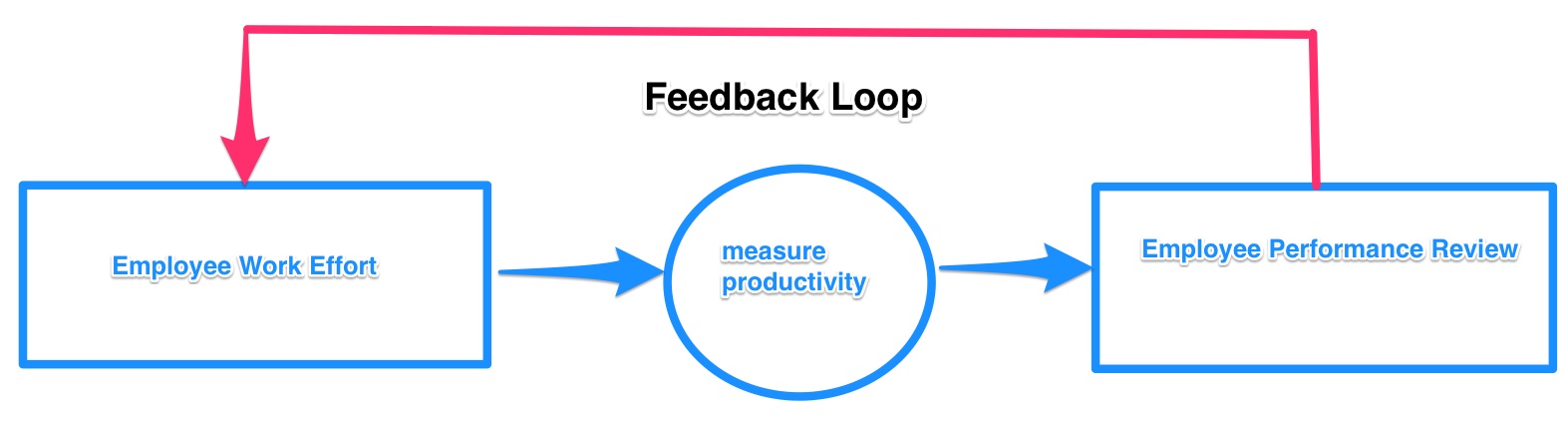
 

Positive feedback loop for the measure is the metric post.
Positive feedback loop in a simple system

So, by the mere act of being measured, we change what is being measured.  The measure is the metric.

And it shouldn’t be too hard to figure out that WHAT you measure and WHAT you choose to be the metric are more important than you think.
HIMSS 2014 Meeting – The online experience

HIMSS 2014 Meeting – The online experience

I attended the first day of #HIMSS 2014 via the web (schedule conflict).  I haven’t been to a HIMSS conference before, and wasn’t really sure how relevant it would be to me as a physician interested in healthcare tech. Here is my takeaway.

1.  Very different than a medical conference.   Conflicts of interest were a bit more obvious.  However, in fairness, since industry is providing these solutions (not private research in most cases), you hardly would expect people not to toot their own horn.

2.  Keynote opener from Aetna’s CEO Mark Bertolini – was pretty consistent from what I’ve seen from insurers in the past.  Not right, not wrong, just really the point of view from an insurer.  Differences –  The usual slides on waste in healthcare were trotted out ($800 billion, but waste exists in the insurance industry too!)  Discussion of unsustainable increase in healthcare premia and progressive cost shifting to the consumer from employers who remain focused on defined contributions.  Some trends towards commodization of care, but also discussion of ACO/PCMH focused factory model of selecting the doctors that provide the best care at the lowest cost (a great #bigdata application if there was ever one).  What was interesting was how he seems to have seized upon #hotspotting of healthcare ‘super-users’ (1) as a tool for future care delivery and cost savings.  As these super-users tend to have two or more chronic conditions (and be elderly or disabled with serious medical conditions), they account for a disproportionate amount of care and spending – 1% of the plan members account for 47% of the costs.  He discussed a commitment to these individuals to get their costs down over time.  That’s interesting, because now under the ACA, risks must be underwritten (before they could be avoided, denied under pre-existing conditions, etc…)   I thought that this was a new and constructive approach – I’m curious to know how many of the other large insurance CEO’s are taking this approach.  From an executive perspective, I agree with it.

One other thing that was discussed was the use of connected devices in #heart failure.  He discussed the partnership of Aetna with Medtronic in the realm of pacemaker data – briefly discussed looking at how electrical impedance which was being routinely collected and data sent back to medtronic – could be used as a predictive analytic of impending CHF (heart failure).  This to me is significant – first because it is a great use of #bigdata analytics, second because it touches on the reality that there are huge private databases of clinical data that can be tapped in new and creative ways to improve patient care.  If this isn’t an argument for #opendata, what is?

3.  Next Web Transmitted Lecture ‘Securing Patient data in a mobilized world’ was about mobile data security.  Well done, nothing ground shaking, a good introduction to cybersecurity for the uninitiated.  Take away point – either use Citrix or Mobile Data Management software to remain HIPAA compliant!

4.  Next Web Transmitted Lecture was ‘Do you have hidden ROI’ was a decent high level discussion of challenges and benefits of technology implementation, with much emphasis on change management.  Good high level discussion, but the ‘ROI’ discussed was more of a soft return on investment (we see things are working better, and our patients/providers like it) as opposed to a quantifiable number.

While I thought the web based sessions were solid, I would liked to have had more variety and certainly some of the titles in the meeting which were not broadcast would have been my choice over these two topics (aside from the keynote).  Twitter under the #HIMSS2014 hashtag was insanely active – a firehose of information.   We’ll need some filtering there to make it useful!  

FYI – while Hillary Clinton is scheduled to speak to the live crowd, there will be no webcast, live or delayed.  A number of participants are upset over this.

Finally, there seems to be a good amount of additional material on the website – a number of lectures were placed online pre-recorded, and there are ‘e-sessions’ which appear similar.  I watched about half of a presentation on big data, which seemed to be well-done & I plan to go back and finish it.

I may post more on this topic if encouraged to do so.  
(1) http://medcitynews.com/2014/02/hot-spotting-healthcare-growing-trend-hospitals-find-super-users/

OODA loops – a definition and thoughts on application to healthcare

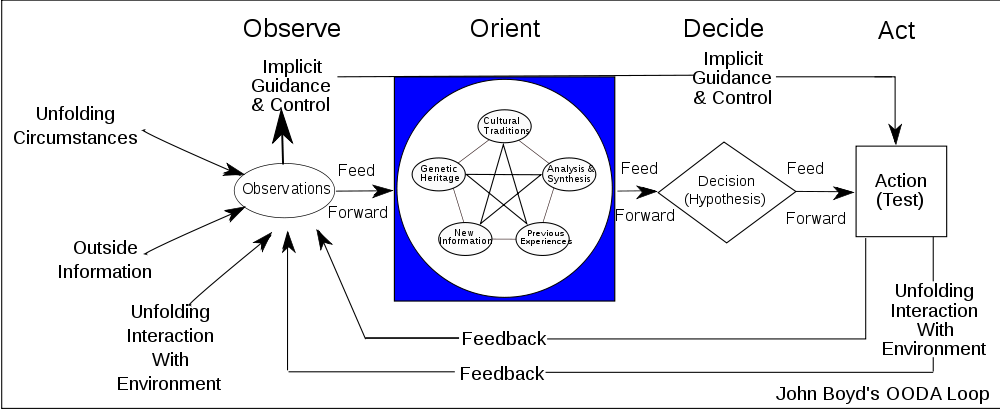
John Boyd's OODA loop
John Boyd’s OODA loop


John Boyd was a US military pilot who became a military strategist. His chief contribution to military theory was contained in a large slide presentation and one essay, but his teachings heavily influenced those who train our military commanders and are incorporated into US military strategy and tactics. Boyd characterized the decision-making process as a means of a continuous (iterative) cycle of Observation – Orientation – Decision – and Action. This OODA loop is the mechanism enabling adaption and therefore survival.

The observation process involves data gathering, orientation is analysis and synthesis, decision is determination of course of action, and action is the execution of that decision, with resultant consequence. Boyd felt that any model is incomplete (including our own perception of reality) and must be continuously refined or adapted in the setting of new data. This is in the setting of increasing entropy (disorder, uncertainty) of any system once it perturbs from the initial point, which we perceive incompletely and imprecisely due to our human limitations. There’s actually a not insubstantial amount of philosophic thought in that!

It is easiest to conceive of the OODA loop in the setting of a dogfight between two fighter pilots. Each pilot is feeling out the other, maneuvering in a certain way that will best give them the kill, ensuring their own personal survival. The OODA loop is by definition, reactive. But the victorious pilot will be able to out-think his opponent by leaving his own OODA loop and getting inside his opponent’s OODA loop, and therefore predict what that pilot is likely to do. That ability to be predictive with a reasonable certainty, allows the winning pilot to best his opponent, all other things being similar. (skill, plane, etc..)

OODA loops have been applied successfully in business, sports, and particularly in litigation.

In healthcare, physicians have their own worldview or OODA loop. They observe patients, orient their differential, decide on a diagnosis and treatment, and then act on that treatment and observe their results, trying something else if unsuccessful. More experienced or better clinicians have very well-developed, almost algorithmic, OODA loops. They also are functioning in their environment (the practice, the wards, the OR) where they have very specific, well-developed skills to assess when something is amiss – patient flow, quietness, absence of something as opposed to glaring signs (like alarms, etc…).

You could hardly expect the healthcare administrator to have the same OODA loop. Note the Cultural Traditions in the blue box – very different for both! So when the two interact, so do these loops, and may lead to some unsatisfying conversations if there is no empathy between the administrator and the physician. The physician communicates to the administrator, and the administrator communicates back, but neither is understanding what the other is saying. It probably falls upon the more emotionally intelligent of the two to try to get inside the OODA loop of the other to facilitate a truly constructive conversation. Without practiced understanding, the physician risks being labeled ‘disruptive’ and the administrator risks being thought of as ‘unfair’.

Venkatesh Rao, of the sublime ribbonfarm blog, has an older post on his Tempo book blog about OODA’s backstory. I have ‘borrowed’ his OODA diagram here.

I finally got around to writing the companion update to this post – it concerns OODA loops and AI.  I invite you to read it.

The Physician & the Administrator – Rule Sets in Healthcare

I came across the idea of rule sets while reading Tom Barnett’s excellent The Pentagon’s New Map.(1)  Tom is a military strategist who was influential in the 1990’s-2000’s when the collapse of the Soviet Union left the US as the sole hegemonic power (this was before the 2008 Western financial crisis and China’s ascendancy).  I had the pleasure of corresponding with Tom on a few of his ideas which at the time seemed quite radical, but bore out to be accurate.  I’m not going to comment on his military and geopolitical views, as I’m only an armchair foreign analyst.  


Tom promotes the idea of “Rule Sets” – the combined written and unwritten rules that exist in a society or culture.  Entities that have similar rule sets interact and cooperate more effectively, and entities that have very different rule sets have difficulty synergizing well.  Ergo, western cultures (US & European) interface quite well as we have a shared belief system – representative democracy, protection of private property, freedom of religion, rule of law, etc…   However, cultures such as American and Azerbaijan may not interface easily as paternalism, tribal and familial patterns of voting and class, arranged marriages clash between the two cultures (apologies to any Azeris who feel I am unfairly singling them out for the purposes of example).


In healthcare today, we have different rule sets belonging to the various stakeholders involved in healthcare delivery.  The differences between these rule sets create friction in interaction, even when one group asserts dominance over the other.


The physician’s rule set is first and foremost governed by the Hippocratic “primum no nocere” (first do no harm) dictum.  As a result, most physicians are risk-averse, patient-centric, and conscientiously compliance focused, also stemming in part from a fear of malpractice and payment compliance problems.  They are also cognizant of the “captain of the ship” doctrine as it has applied to them (z.b. this may be changing in practice if not as quickly in case law) and are therefore independent and opinionated, not concerned about consensus-building as their decisions tend to be of the “buck stops here” variety.  Consumed by the frequent changes in the medical literature that make up the basis of their practice, they tend to be resistant to other forms of change.  Success is typically measured internally by the satisfaction derived from good patient outcomes, a patient at a time.


The administrator’s rule set is more nuanced with greater attention to soft skills, team and consensus building, and an avoidance of unnecessary risk.  Slow, iterative refinements punctuated by less frequent sweeping change either in response to market conditions or strategic initiatives are the rule.   For all but the highest level administrators, shared decision making is the rule, requiring buy-in from different organizational levels.  Institutional knowledge and know-how are as important as efficient execution and interpersonal skills.  Productivity enhancement is a sure key to success and greater roles in the organization.  Mid-level managers tend to be more narrowly focused, myopically on their own area of supervision and control, while higher level executives are responsible for institutional stewardship.  Success is usually measurable by numbers, either in a P&L basis, volume, time, or outcomes measures.  Responsible for many lives, the administrator focuses on population health measures.  


So, if physician’s rule sets and administrator’s rule sets are so different, how then are we to expect the two to collaborate successfully?


Perhaps a new rule set will need to be developed with commonalities both physicians and administrators?  


They already have one huge thing in common – the patient.


(1) Thomas P.M. Barnett (April 22, 2004). The Pentagon’s New Map. Putnam Publishing Group. ISBN 0-399-15175-3